
Splitting the Marathon Long Run

 photo credit: Kaunokainen
Everything has an equal, opposing element if you can find it.
The marathon is considered by many to be running’s ultimate test. But as anyone who as trained for a marathon can tell you, the real challenges happens long before race day or the dreaded “wall.” It’s the hard work you do in the weeks and months prior to your race that can make — or break — your performance on race day. Balancing training and recovery can be a full-time job, but you can make it easier on yourself by taking the radical step of splitting your long run.
The Role of the Long Run
The long run is a critical component of any marathon training plan, as it’s where you build the endurance and experience that will help you on race day. Distances vary, but most marathon plans will have long runs that peak out somewhere between 18 and 22 miles.
Athletes who run 10 minute miles or slower will be running anywhere from three to five hours! It’s no coincidence that so many middle of the pack runners suffer overuse injuries. After all, they consistently run one-and-a-half to two times longer than their faster counterparts.
In other words, no one single run is what prepares you for your race. It is the effect of training your body over weeks and months — and the ability to focus that fitness on the big day with your race execution — that will give you the results you seek. Your can reap the benefits of a 45 mile run week by splitting that long 20 miler into two efforts without suffering the consequences of putting 50% of your weekly mileage into one session and overwhelming your body.
A Quick Example
Let’s look at a long run of 2.5 hours for our friends Speedy Stan (7:00/miles) and Wandering Wally (12:00/miles). Both athletes are running the same effort for the same time. The only difference is that Stan can rack up 21+ miles while Wally covers 12.5 miles. They are doing the same work (as measured by Effort times Time), it’s just that Stan’s output is much higher.
They both need to cover 20 miles per their shared training plan, but for Wally that means running an additional 90 minutes on top of what Stan has done. In other words, Wally faces the prospect of doing more work at the point when he is most fatigued and ill-prepared to run well. Like most runners, Wally sucks it up and keeps slogging through his run.
Across a full training program, Wally logs an average of 90 to 150 minutes of more running per week than his buddy Stan. This impacts his ability to recover, increases his fatigue and definitely hampers his ability to fit training in with all the other things in his life. And yet cramming all that hard work into one long run session isn’t necessary for Wally to be his best on race day.
Our Running Plans Now Online at Endurance Nation!UltraDistance | Marathon Plans | Half Marathon Plans | 10k Plans | 5k Plans |
Your Body & The Cost of Running Longer than 2.5 Hours
Inside Marathon Nation we don’t advocate long runs over 2.5 hours, although you can do runs up to about 3 hours if you are fit and able to dedicate time to recovery. We can do this since we incorporate a good amount of intensity in our training plans, even the long runs. This increased effort offsets the need to go longer at an easier pace, as we are earning the same training stress.
The longer you run over the 2.5 hour mark, the risk of getting injured and/or over-trained is significantly increased. Yet you aren’t gaining any additional fitness that couldn’t be achieved in shorter runs with better technique. In other words that costs of running longer significantly outweigh any potential benefits.
Aside from the increased risks, it’s important to note that once you have hit the two hour mark on a long run, your body is pretty much functioning a total marathon capacity. You are fueling up as your glycogen stores are dwindling and you are hydrating to offset water loss. Nothing else magical happens to you after your body has reached this point other than needing the mental strength to continue on to the finish line.
The Long Run and Race Day
One of the most convincing arguments about not splitting will come from anyone who followed a conservative running plan and then had a bad race experience. Somewhere around mile 16 to 20, things got really bad…must have been the lack of a long run, right? Wrong!
Most of the time poor race experiences are a function of poor race execution. This includes everything from poor pacing at the start to poor overall pace selection, from insufficient food to the fact that running 26.2 miles is hard. Really hard.
Don’t be deceived by these individual tales of doom. A solid program will get you fit and knowing how to execute makes a huge difference. If you need race execution guidance, be sure to download our quick reference sheet and video here.
Wholistic Training & Bigger Picture Goals
The most important thing to consider during your internal debate about splitting boils down to this: Can you accept that your your marathon fitness — not your training — is the sum of countless hours of individual sessions compiled over weeks of working out. That speedwork, hill work, skill work and yes, long runs, all combine to make you fitter and stronger during the training cycle.
If you can agree to this simple truth, then it follows then that adjusting just 2-3 runs out of 100+ workouts will not undermine your ability to run to your potential. It will take some schedule juggling and focus during the training, but it will help insure that you meet your biggest goal: arriving at the starting line healthy and ready to go.
You can’t overestimate the importance of showing up to the marathon starting line 100% physically and mentally ready to race. Middle of the pack runners are plagued with over-use injuries because they spend significantly more time running than their swifter counterparts (since they follow the same training plans!). Running 2 hours longer than a 3.5 hour marathon finisher is already hard enough; doing it with cortisone shots in your hip, knee, calf, and/or foot doesn’t make it any more bearable. A healthy runner is a happy runner.
Splitting Options
There are several different ways that you can split your long run workout. Here they are in best possible order; you pick the option that best works for your schedule.
Option A: Split Morning and Night (12 Hours)
This is the best possible option, as it allows for active recovery during your day and ensures you are still carrying some fatigue into that second run. It can be tricky to manage your food across a single day, as you’ll need to recovery from the first run but don’t want to be too bloated / heavy for the second effort.
EXAMPLE: Split a four hour run into 2.5 hours in the AM, 1.5 hours in the PM.
Option B: Split Night and Morning (12 Hours)
A close second to Option A, as this choice means you will be getting a bit more rest with a night of sleep between the two efforts. This additional rest option makes it ideal for beginner marathoners or folks who will be running over 5 hours to cover the long run distance.
EXAMPLE: Split a five hour run as 3 hours on Saturday afternoon, then do 2 hours on Sunday morning.
Option C: Split Morning and Morning (24 Hours)
Also know as the “weekend option,” this plan would allow you to split the long run to a pretty reasonable Saturday and Sunday morning schedule. Not as optimal as the other options listed above, but certainly very doable.
EXAMPLE: Split a five hour run as 3 hours on Day One an 2 hours on Day Two.
Option D: Split Thursday and Saturday (36+ Hours)
This is the least ideal option as your body will be 100% recovered before the next run. That said, some times life gives us no other option. Ideally you would be able to do this as a PM effort for the first run and an AM effort for the second, keeping the runs to about 36 hours apart.
EXAMPLE: Split a five hour run as 2.5 hours on Thursday and 2.5 hours on Saturday.
Splitting A Marathon Plan
Of course any marathon plan has more than just one long run in it. Odds are your plan will have anywhere from three to five long runs of 18-miles or longer. Three long runs as 18, 20 and 22 miles for the 10:00/mile runner (or slower) means splitting some or all of the runs.
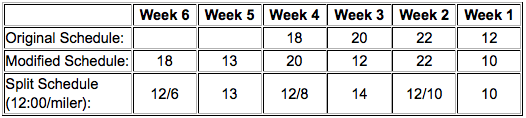
If your plan calls for 18, 20, and 22 mile runs consecutively — that’s very aggressive. Splitting will help to reduce the impact of the individual workouts and will still allow you to reap the benefits of progressive overload.
Here’s how we suggest you do it: Add a shorter run week between each long run.
Review your training plan early and factor alternating weeks with a single run. Per the table below, our Split Runner will put in “harder” runs in the non-split weeks. This will still provide a challenging program that ensures a progression of fitness without any individual overload workouts.
Cautionary Notes on Splitting
While many folks consider the very act of splitting to be a virtual shortcut, there’s no denying that you are still covering the same miles, in the same time, each and every week. That said, it still feels easier — after all you aren’t suffering through 4 and 5 hour individual sessions. It’s only human nature to then compensate…but you shouldn’t.
Here are the top three things you should not do when splitting.
1 – Do Not Run Faster / Harder Overall
It’s tempting to run the two 2.5 hour blocks faster than you would if it had been one long 5 hour session…but you shouldn’t. Remember that the effects of too much on your long runs only appear downstream. What feels okay now might contribute to a problem in 3-5 weeks. Instead, run your workouts like you would any long run. Make it through your cycle and your race, then you can adjust. T
2 – Do Not Split Every Long Run
This technique is really only recommended for your longest efforts; the ones nearing or exceeding the three-hour mark. You still need to build up your endurance and durability, and you can achieve this over the beginning weeks and months of your marathon program. Just remember that you will most likely need to alter your plan by working backwards from the last long run weekend per the table above, so definitely plan ahead!
3 – Do Not Go Crazy Between Split Runs
Splitting runs within the preferred 12-hour window means precious little time to recover and refuel. Add in the fact that you have a life and other commitments, and chances are you won’t be spending too much time with your feet up!
While active recovery is great, you still need to be careful not to overdo it. Going shopping or cheering on your kid’s soccer game is great; mowing the lawn is not. Tidying up the house and doing laundry is okay; spending two hours tending your garden in the midday heat — not good.
I really hope this advice helps you make running a fun and reasonable part of your fit lifestyle. Training for a marathon is a massive undertaking, and it’s important to remember that while we all seek the same finish line, nothing says we all have to train the same way to reach it.
Done properly, you will get fitter and develop a new passion for going long. Good luck!
———————
As always, I just wanted to thank you for subscribing. This blog is a success because of you and your support. Here’s to your fitness!
Become a Fan of Marathon Nation on Facebook to join the conversation and consider starting a two-week free trial to learn more about Marathon Nation.
Thank you so much!
13 Responses to “Splitting the Marathon Long Run”